
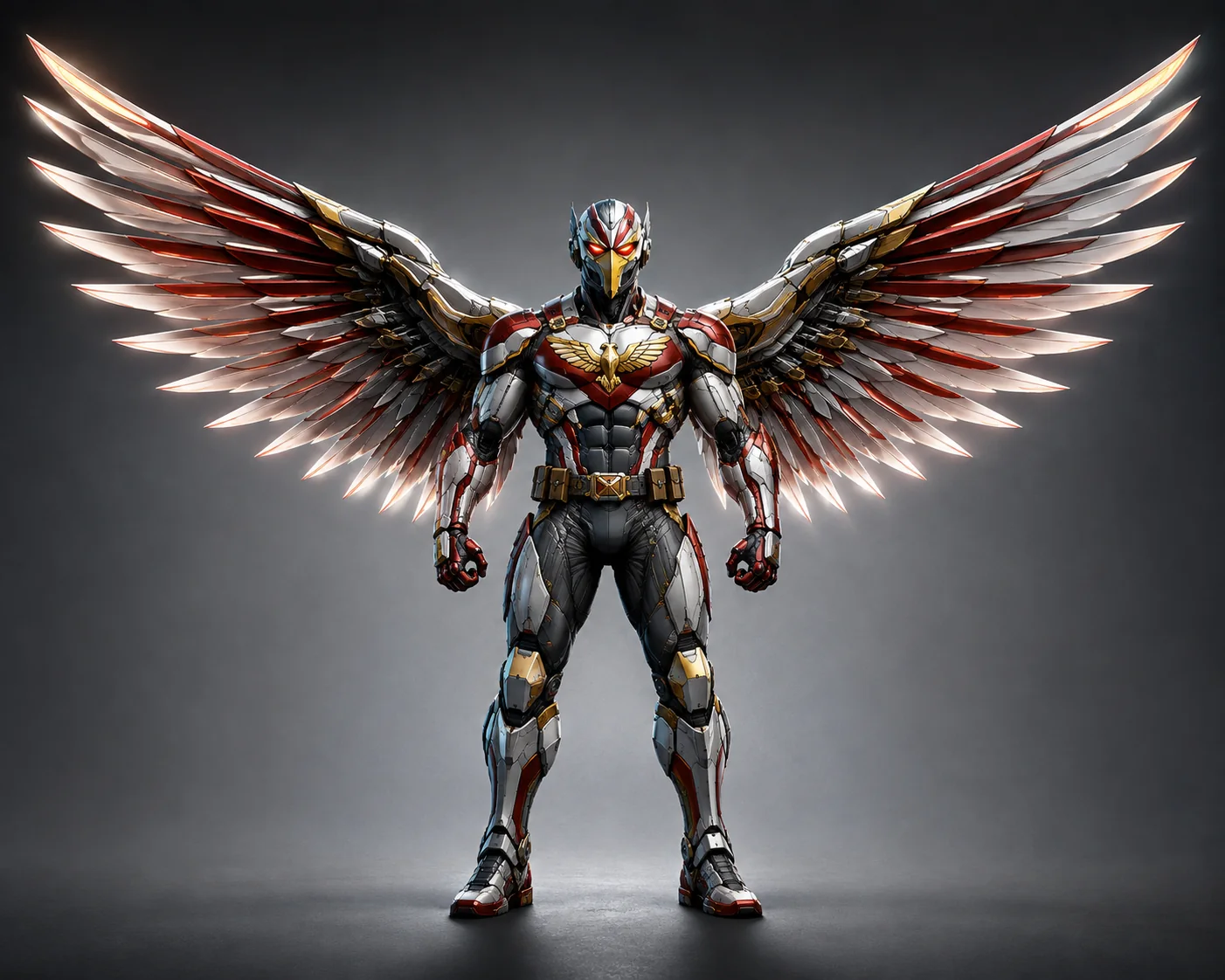
Hero under pressure
Eagle Wing
A baseline human who built himself into one of the world's most recognizable heroic symbols while carrying fractures the public cannot see.
- Real Name
- James Adrian Judd
- Power Category
- Technology / Aerial Combat
- Story Layer
- Tier 1
Why They Matter
A baseline human who built himself into one of the world's most recognizable heroic symbols while carrying fractures the public cannot see.
Who They Were
James Judd is a Skyhaven University alumnus, the CEO of Judd Metrology, and the man behind Eagle Wing. His public image represents control, competence, and protection. Beneath that symbol is a fractured internal life shaped by James, Jay, Jack, and the internalized Eagle Wing identity.
The choices that still follow them
The Story That Made Them
The Moment Everything Changed
James inherited a family enterprise built on aerospace, adaptive materials, and autonomous systems, then reorganized it into modern Judd Metrology. Those engineering capabilities supported its expansion into AGC measurement and the flight systems that allow a baseline human to stand beside altered and cosmic beings.
What UMED Can Measure
UMED-SKY-P,T-4-0001
- 01P — Pure Human
- 02T — Tech Enhanced
United Metro Enforcement Division
UMED Field Profile
Provisional capability estimates
UMED-SKY-P,T-4-0001
Capability ratings use a separate 1-7 scale, with higher numbers indicating greater capability in each category. They apply to biological, technological, mystical, and other abilities. Provisional values are estimates awaiting verification. These ratings are distinct from response levels and Judd Metrology's scientific findings. Empty channels indicate an assessment is pending, never a zero rating.
What They Can Do
01Baseline human physiology
James has no innate superhuman ability or active AGC expression. His effectiveness comes from training, engineering, preparation, and the systems built into the Eagle Wing platform.
UMED classification: Pure Human / Tech Enhanced02Aerial combat mastery
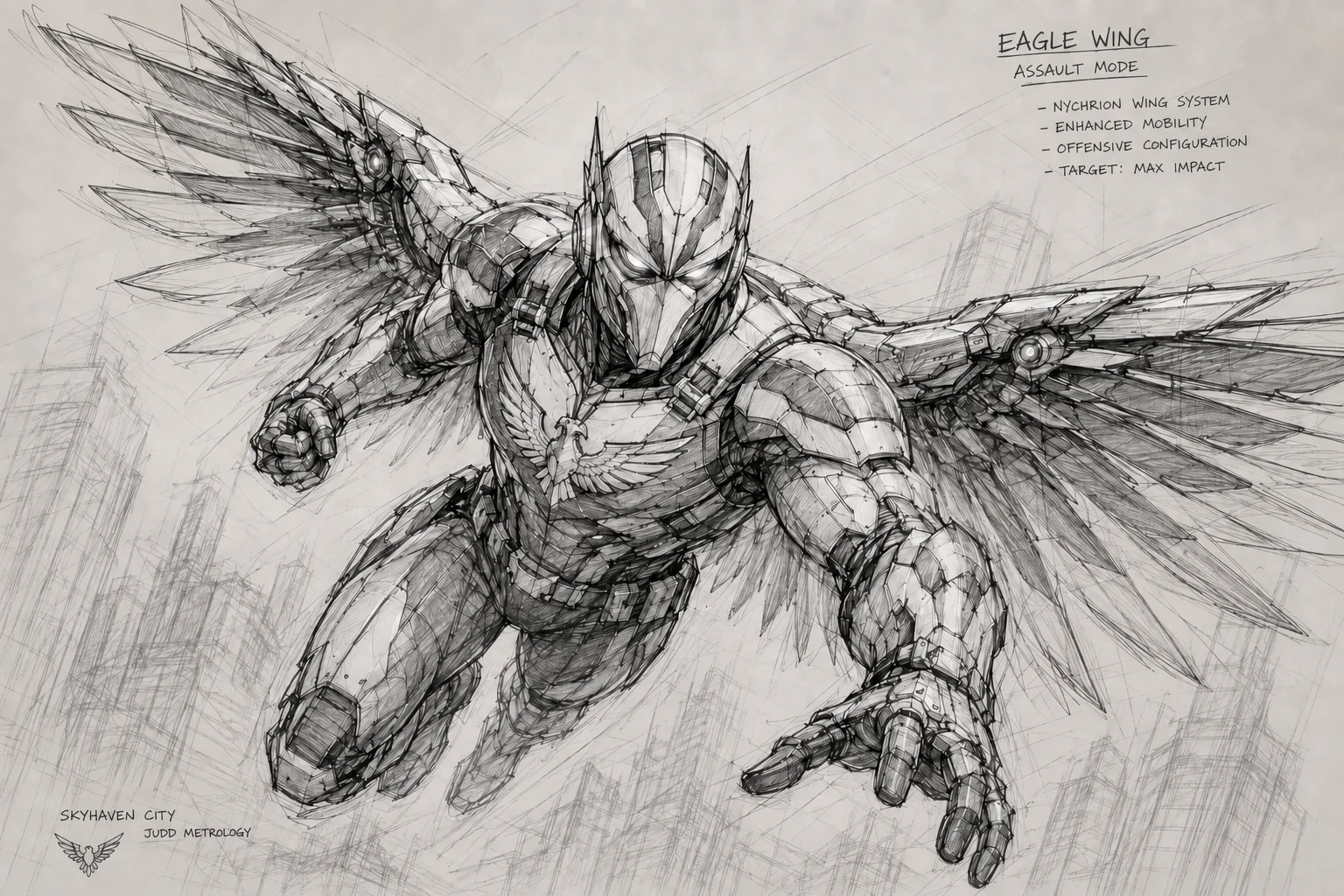
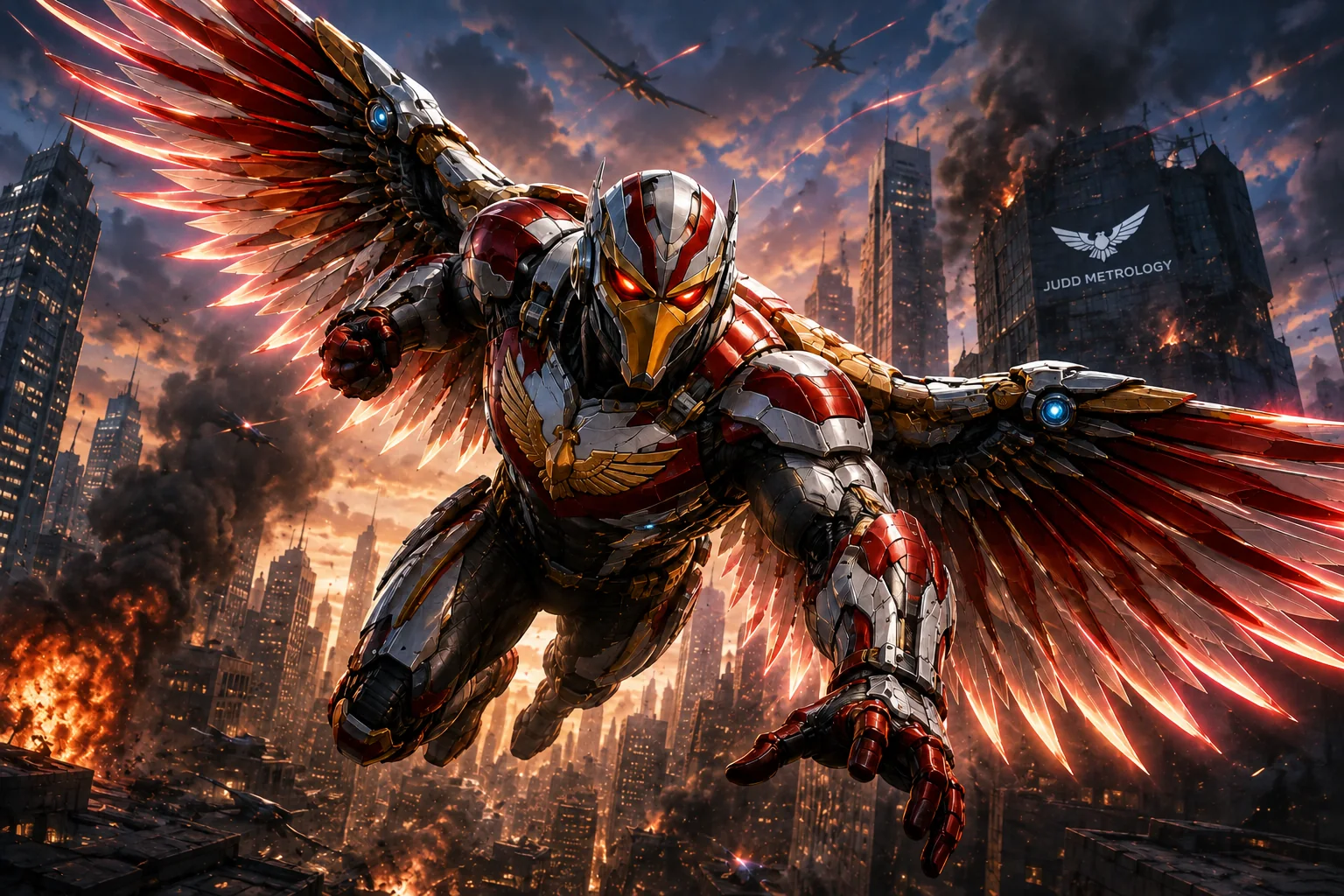
The wing platform gives Eagle Wing high-speed flight, sharp direction changes, stationary hover, emergency braking, and the ability to fight across vertical space. Judd telemetry continuously adjusts each feather segment to keep the suit stable.
03Nychrion force management
Nychrion sections absorb and redistribute physical or energy impact. Eagle Wing can fold the wings into a shield, redirect part of an incoming strike, or store limited energy for a controlled counterattack.
04Adaptive tactical combat
James combines disciplined close-quarters training with real-time flight data and environmental analysis. The system can move between rescue, pursuit, defense, and assault configurations without requiring a full landing.
05AGC analytical expertise
As the head of Judd Metrology, James can read AGC output, instability, and activation behavior in the field. This does not neutralize a power, but it helps him understand what is changing before a situation becomes catastrophic.
What They Carry
01Nychrion wing system
A modular mechanical wing platform built around Nychrion feather segments. It provides lift, defense, guided feather deployment, precision flight control, and multiple combat configurations.
02Advanced flight armor
A sealed protective suit designed for high-G turns, atmospheric exposure, impact survival, and urban combat. Reinforced gauntlets and boots add micro-thrusters, anchors, and retractable talons.
03Judd Metrology AGC telemetry
A live measurement suite that tracks anomalous output, environmental change, activation thresholds, and physiological risk. It gives Eagle Wing usable field data without pretending every power follows the same rules.
04G.L.I.D.E. tactical interface
The onboard intelligence manages flight paths, power distribution, suit integrity, target priority, and emergency response. It advises James but does not replace his judgment.
05Nychrion blades and talons
Close-range tools integrated into the wings, gauntlets, and boots. They can cut reinforced material, anchor the suit during rescue work, and provide controlled striking options when flight space disappears.
06Sonic and electronic countermeasures
Directed sonic pulses, encrypted communications, EMP tools, and surveillance countermeasures let Eagle Wing disrupt drones, break hostile coordination, and create escape windows without relying only on force.
How the advantage is built
Inside the Armor and Flight Systems
Where They Can Break
01Psychological fragmentation
Stress can destabilize the balance between James, Jay, Jack, and the Eagle Wing identity. A shift can change judgment, restraint, and combat behavior faster than the suit can compensate.
02Human limits outside the armor
Without the suit, James can be injured, exhausted, restrained, or killed like any other highly trained human. The armor raises his operational ceiling; it does not change his biology.
03Family trauma
Sarah's death and the hidden truth surrounding Jake can be used to disrupt James's focus. His need to protect the Judd legacy sometimes competes with the truth a situation requires.
04Technology dependence
Damage to the wings, power core, flight controls, or G.L.I.D.E. can sharply reduce mobility and protection. Nychrion is durable, but the systems connecting it are engineered and therefore vulnerable.
Who Claims Their Loyalty
- 01
- 02
What They Inherited
- 01
- 02
Who Stands With Them
- 01
- 02
- 03
Who Wants Them Stopped
- 01
- 02
Where to Meet Them
- 01
- 02
Stories That Change Them
- 01
See Them in Action
Details Worth Knowing
- 01Core themes: identity, control, heroism as performance, family, truth versus myth.
Whose Story Connects
- 01
- 02
- 03